
Satellite Cybersecurity: Protecting Space Assets from Modern Threats
Space has become an essential part of modern life. Satellites support GPS navigation, weather forecasting, financial transactions, telecommunications, internet connectivity, Earth observation, and military operations. As governments and private organizations continue to launch satellites at an unprecedented rate, cybersecurity has emerged as one of the most critical challenges facing the space industry.
Historically, space security discussions focused on physical threats such as collisions, space debris, and equipment failures. Today, cyber threats have become equally significant. As satellites become increasingly software-driven and interconnected with terrestrial networks, they create new attack surfaces that sophisticated threat actors can exploit.
A successful cyberattack against a satellite can disrupt communications, navigation services, Earth observation capabilities, and defense operations. The consequences can extend far beyond the space sector, affecting national security, economic stability, and critical infrastructure worldwide.
Why Satellite Cybersecurity Matters More Than Ever
The number of satellites orbiting Earth has increased dramatically over the past decade. The growth of commercial space companies, satellite internet providers, Earth observation platforms, and national space programs has accelerated the deployment of connected space systems.
Modern satellites are no longer isolated assets. They operate as part of a larger ecosystem that includes:
- Ground control stations
- Communication networks
- Cloud infrastructure
- Mission control systems
- Third-party software providers
- Data processing platforms
- Remote operators and contractors
This interconnected environment creates additional opportunities for cybercriminals, nation-state actors, and advanced persistent threats (APTs) to target space infrastructure.
As organizations become increasingly dependent on satellite-based services, attackers recognize the strategic value of compromising these systems. A successful breach can disrupt communications, manipulate navigation signals, intercept sensitive information, or interfere with mission-critical operations.
Understanding the Modern Satellite Attack Surface
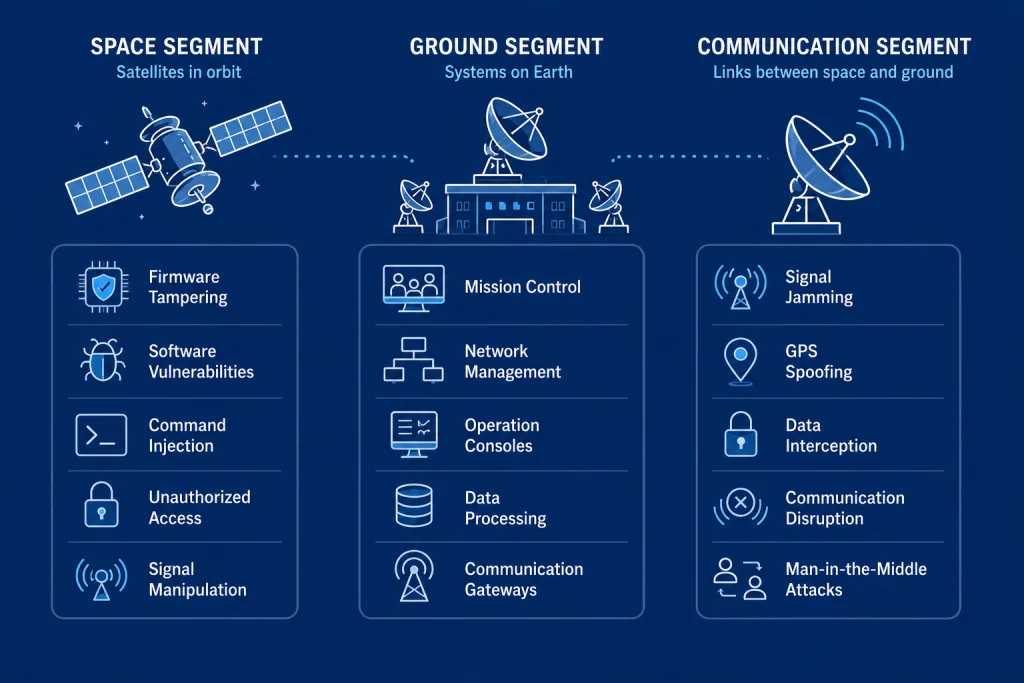
Many people assume cyberattacks against satellites occur directly in orbit. In reality, attackers often target supporting infrastructure on Earth.
A typical satellite ecosystem consists of three primary segments.
Space Segment
The space segment includes satellites, onboard computers, communication payloads, sensors, and software systems operating in orbit.
Potential attack vectors include:
- Malicious firmware updates
- Software vulnerability exploitation
- Command injection attacks
- Unauthorized access to onboard systems
- Signal manipulation
Ground Segment
Ground stations are among the most attractive targets for attackers because they provide direct access to satellite management functions.
Ground infrastructure includes:
- Mission control centers
- Network management systems
- Satellite operation consoles
- Data processing environments
- Communication gateways
A successful compromise of a ground station can provide access to satellite control functions without directly attacking the spacecraft.
Communication Segment
The communication links connecting satellites and ground stations present another critical attack surface.
Common threats include:
- Signal jamming
- GPS spoofing
- Data interception
- Communication disruption
- Man-in-the-middle attacks
Securing all three segments is essential for a resilient space cybersecurity strategy.
Common Cyber Threats Targeting Satellites
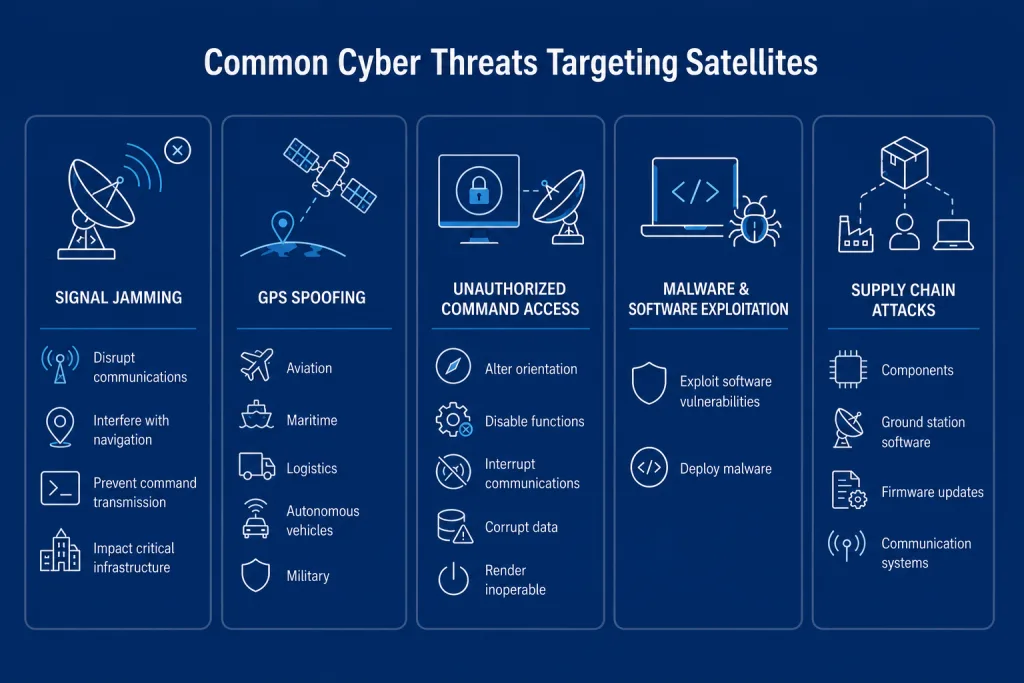
As cyberattacks continue to evolve, satellite operators face an increasingly diverse threat landscape.
Signal Jamming
Signal jamming involves transmitting radio frequency signals that interfere with legitimate satellite communications.
Attackers may use jamming to:
- Disrupt communications
- Interfere with navigation systems
- Prevent command transmission
- Impact critical infrastructure operations
Even short disruptions can have significant consequences for industries that rely heavily on satellite connectivity.
GPS Spoofing
GPS spoofing occurs when attackers transmit counterfeit positioning signals that cause receivers to calculate incorrect locations.
This attack can impact:
- Aviation systems
- Maritime navigation
- Logistics operations
- Autonomous vehicles
- Military applications
As dependence on satellite navigation grows, GPS spoofing remains a major cybersecurity concern.
Unauthorized Satellite Command Access
If attackers gain access to command and control systems, they may issue unauthorized instructions to satellites.
Potential consequences include:
- Altering satellite orientation
- Disabling critical functions
- Interrupting communications
- Corrupting data
- Rendering systems inoperable
Malware and Software Exploitation
Modern satellites rely heavily on software for mission operations.
Unpatched vulnerabilities, insecure coding practices, and compromised software supply chains can provide opportunities for attackers to deploy malware or exploit weaknesses within satellite systems.
As software-defined satellites become more common, secure software development and vulnerability management become increasingly important.
Supply Chain Attacks
The space industry depends on a vast network of suppliers, manufacturers, software vendors, and service providers.
A compromised supplier can introduce vulnerabilities into:
- Satellite components
- Ground station software
- Firmware updates
- Communication systems
The growing sophistication of supply chain attacks makes vendor security assessments a critical component of satellite cybersecurity.
Why Nation-State Actors Are Interested in Space Systems
Space infrastructure has become a strategic asset for governments worldwide.
Satellites support:
- Military communications
- Intelligence gathering
- Missile warning systems
- Navigation services
- Critical infrastructure operations
As a result, nation-state threat actors increasingly view satellite systems as valuable targets during geopolitical conflicts.
Cyberattacks against space infrastructure can provide strategic advantages without requiring direct military engagement, making them an attractive tool in modern cyber warfare.
The Growing Importance of Threat Detection in Space Infrastructure
One of the biggest challenges in satellite cybersecurity is detecting threats before they cause significant disruption.
Traditional perimeter-based security approaches are often insufficient in highly distributed space environments.
Organizations operating space infrastructure require continuous visibility across:
- Ground networks
- Communication channels
- Cloud platforms
- Satellite management systems
- Operational technology environments
Real-time monitoring enables security teams to identify suspicious activity, investigate anomalies, and respond to incidents before attackers achieve their objectives.
As attackers adopt increasingly stealthy techniques, advanced threat detection capabilities become essential.
How Vulnerability Assessments Improve Satellite Security
Many organizations focus heavily on protecting satellites while overlooking vulnerabilities within supporting infrastructure.
Comprehensive vulnerability assessments help identify weaknesses across the entire ecosystem.
These assessments typically evaluate:
- Ground station networks
- Web applications
- Communication systems
- Cloud environments
- Access management controls
- Third-party integrations
By identifying and remediating vulnerabilities before attackers exploit them, organizations can significantly reduce cyber risk.
Regular vulnerability management is critical as satellite ecosystems become increasingly interconnected.
Penetration Testing for Space Systems
While vulnerability assessments identify weaknesses, penetration testing demonstrates how attackers could exploit those weaknesses in real-world scenarios.
Penetration testing can simulate attacks against:
- Ground station infrastructure
- Satellite control systems
- Remote access platforms
- Communication gateways
- Cloud-based mission environments
These exercises help organizations understand their security posture and strengthen defenses before malicious actors can exploit vulnerabilities.
As cyber threats targeting space technology continue to evolve, regular penetration testing has become a fundamental component of space cybersecurity programs.
Building Cyber Resilience for the Space Industry
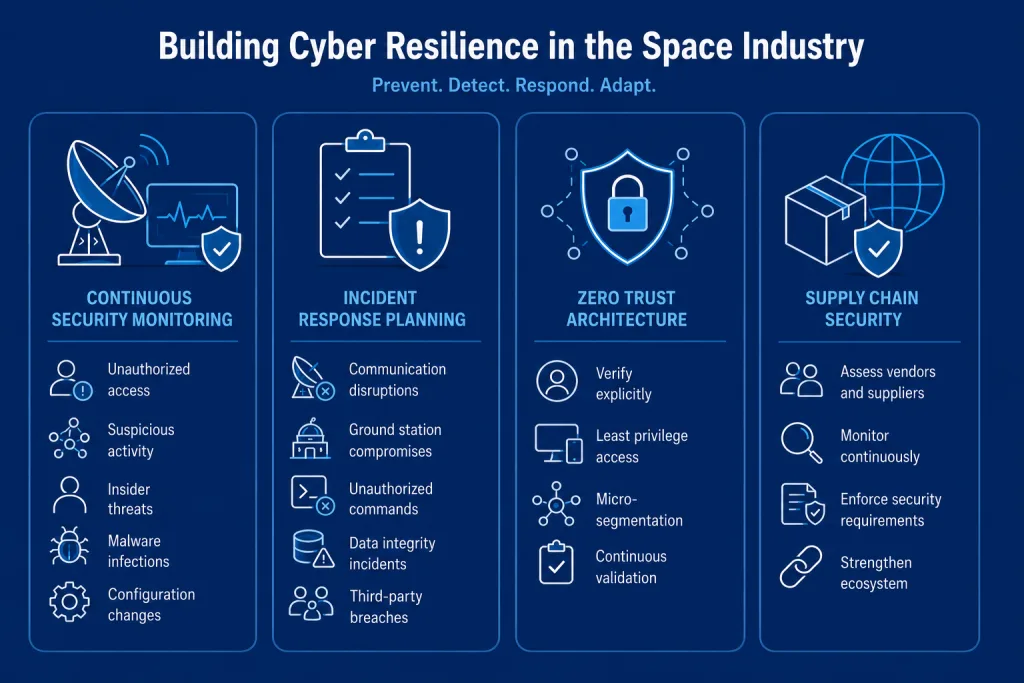
Preventing every cyberattack is impossible. Organizations must focus not only on prevention but also on resilience.
Cyber resilience ensures that critical systems continue operating even during security incidents.
Continuous Security Monitoring
Organizations must maintain visibility across critical systems and communication channels.
Continuous monitoring helps detect:
- Unauthorized access attempts
- Suspicious network activity
- Insider threats
- Malware infections
- Configuration changes
Incident Response Planning
Satellite operators should develop incident response procedures specifically designed for space infrastructure.
Response plans should address:
- Communication disruptions
- Ground station compromises
- Unauthorized command activity
- Data integrity incidents
- Third-party security breaches
Zero Trust Architecture
Traditional trust models are increasingly ineffective in distributed environments.
A Zero Trust approach assumes that no user, device, or system should be trusted automatically.
Implementing Zero Trust principles helps reduce unauthorized access and lateral movement across satellite ecosystems.
Supply Chain Security
Organizations should continuously assess vendors, suppliers, and third-party partners to reduce supply chain risk.
Security assessments, monitoring programs, and contractual security requirements can help strengthen the overall ecosystem.
The Future of Cybersecurity in Space
The future of space cybersecurity will be shaped by increasing connectivity, automation, artificial intelligence, and commercial innovation.
While these advancements create new opportunities, they also introduce new security challenges.
Future threats may include:
- AI-powered cyberattacks against satellites
- Autonomous satellite security threats
- Advanced signal manipulation techniques
- Cyber warfare targeting space assets
- Attacks against large satellite constellations
Organizations operating in the space sector must proactively evolve their cybersecurity strategies to address these emerging risks.
The ability to detect, respond to, and recover from cyber incidents will become a defining factor in the long-term success of satellite operations and space missions.
Protecting satellite systems requires more than reactive security measures. With cyber threats targeting both space-based assets and ground infrastructure, organizations need a proactive and resilient approach to cybersecurity. Globals helps satellite operators strengthen their security posture through comprehensive assessments, vulnerability identification, and tailored protection strategies designed for the evolving threat landscape. Our team works closely with you to safeguard critical space assets, ensure operational resilience, and support mission continuity.
Contact us today at Globals at: sales@globalsinc.com or +91 80221 70777 to discover how we can help secure your satellite infrastructure.